Additional Commentary: MaineCare Spending & Maine's State Budget
Understanding the drivers and state budget implications of increased General Fund spending on MaineCare, Maine's Medicaid program

As a companion to the Commentary on Maine’s State Budget piece, this post takes a closer look at spending growth in MaineCare, Maine’s Medicaid program. When I joined Governor Paul R. LePage’s Administration in May 2014 as Deputy Commissioner of Finance (CFO role) for Maine’s Department of Health and Human Services (DHHS), Governor LePage and his Administration were not far removed from repaying Maine’s hospitals the large Medicaid debt owed them by state government and from putting MaineCare back on sound financial footing. Keeping the program there was a key priority of the Administration’s, and a good deal of my work at DHHS was focused on that objective.
While I am proud of the work, I write primarily from my two subsequent vantage points: (1) as State Finance Commissioner1 — a step removed from oversight of MaineCare finances but deeply aware of how important they are to keeping the General Fund budget in balance and, of course, accountable for any funding issues therein; and (2) as an outside observer (since 2019) with a similar awareness of how critical accurately forecasting and sustainably managing MaineCare program finances are to Maine’s overall state budget.
Acknowledging that this is not the brief (-ish) addendum to the Commentary post that I originally intended, a handful of summary points follow. The broader and more detailed analysis of program spending begins with the “Background Points” section. Thank you as always for your interest.
EXECUTIVE SUMMARY
Medicaid spending is a big part of state budgets — generally the largest after K-12 education, and that is the case in Maine.2 Maine’s Medicaid program, MaineCare, accounts for about 25% of all General Fund spending, meaning that state government uses roughly one-quarter of each income or sales tax dollar it receives to fund MaineCare expenses.3
Over the years, MaineCare has grown considerably. “All Funds,” meaning total program spending from all funding sources, MaineCare was a $1.2 billion program in 2000. In the current fiscal year, FY 2025, it will be about $5 billion.4
At times, such as in the late 2000s / early 2010s period, MaineCare shortfalls have been significant contributors to state budget instability. After a decade-long period of budget stability, MaineCare budget challenges are straining Maine’s broader General Fund budget once again.
Two primary reasons account for this. First, total program growth has accelerated. From FY 2018 to FY 2024, total program costs increased from $2.851 billion to $4.625 billion.5 Second, the rate at which the federal government matches Maine’s Medicaid expenses has declined from ~70% in the early 2020s to ~62% in the current fiscal year. The latter resulted, initially, from the end of a pandemic-era boost in federal matching funds that each state received; and, subsequently, the rise in Maine’s per capita income (which has an inverse effect on the federal matching rate) relative to the national average.6
That joint dynamic, then, of increasing total program costs combined with a declining federal cost-share of Maine’s total Medicaid expenditures has substantially increased MaineCare costs to the General Fund. Rather than approximately 20% of the General Fund budget, which MaineCare accounted for in FYs 2020 to 2023,7 that level is about 25% today — closing in on an all-time high.8
Since the state budget pie is always and only 100%, increased MaineCare General Fund costs are putting pressure on other parts of Maine’s state budget.9 Put simply, for each additional percentage of Maine’s General Fund budget that MaineCare consumes, another area (or other areas) must forgo a corresponding amount.
When windfall revenues—such as Maine experienced in the early 2020s—enable more spending across the board, it is easier for governments to mask (or negate altogether) budget cannibalization. As those revenues flatten, which has happened in Maine more recently, masking efforts begin to fail. The funding decisions become the traditional “either or” rather than the more recent but unsustainable “how much more?” The graphic below illustrates the problem state government is facing, as spending growth rates have spiked and revenue growth has declined.
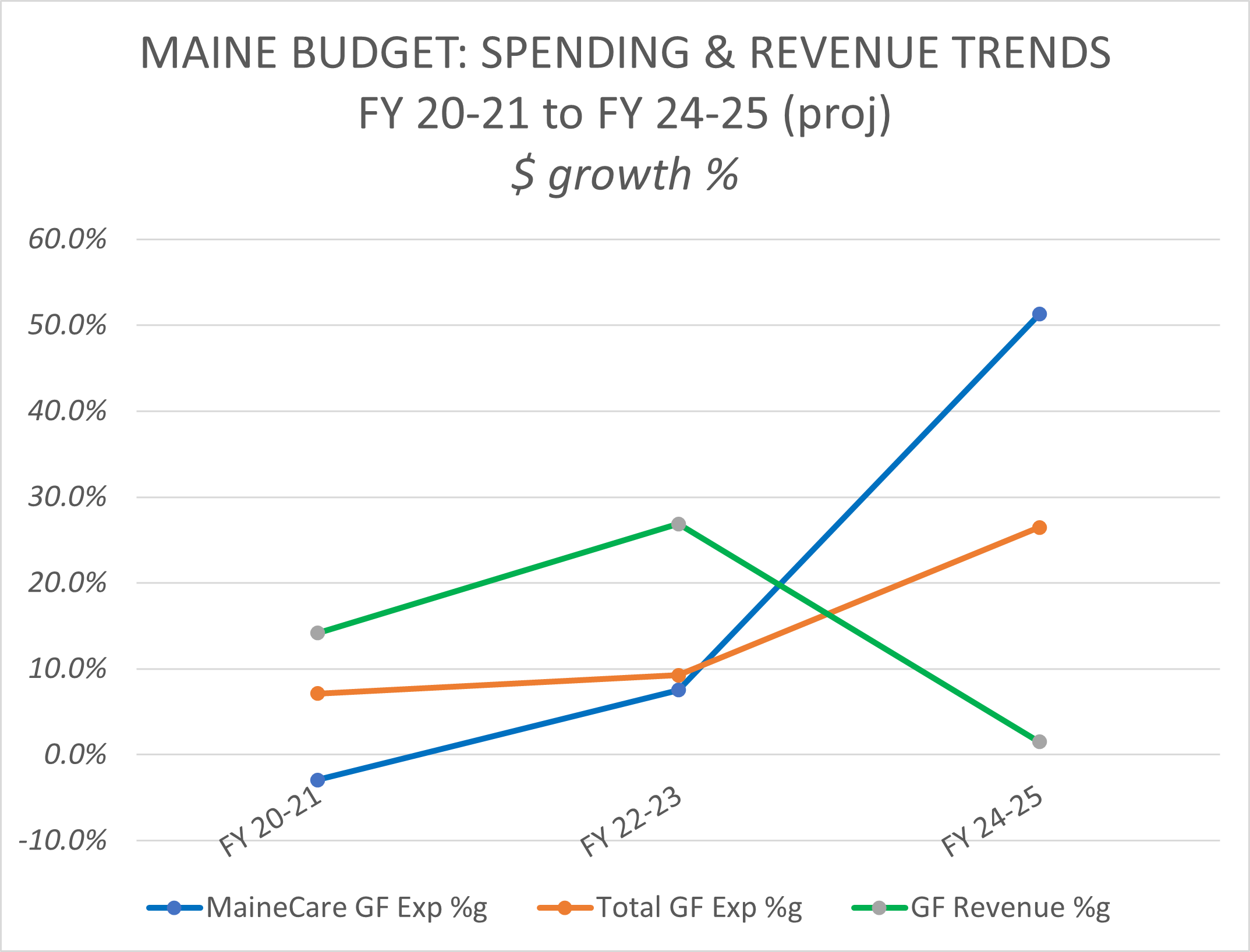
The mix of expenditures (total General Fund and MaineCare General Fund) and revenue growth rates is out of alignment and unsustainable. While the rates of spending growth should moderate in FY 2026-2027—simply because they will not be growing off an artificially low base—the wide spreads in the graphic are concerning. A closer look at each of the lines in the graphic helps explain why.
MaineCare General Fund expenditures growth (blue line). The line’s sharp turn upward is the direct result of total program costs increasing and federal funding for it decreasing. Continued biennial MaineCare General Fund spending growth of ~50% is unlikely because Maine’s constitution requires policymakers to balance our state budget. Nonetheless, what was a $1.608 billion General Fund program as recently as the FY 2018-2019 biennium is projected to cost $2.657 billion for the current one (FY 2024-2025).10 Further, if program General Fund spending growth declined to its All Funds biennial spending growth average of recent years (~18%), that would still outpace projected revenue growth by six times for the coming biennium (FY 2026-2027) and by three times for the following one (FY 2028-2029).11
Total General Fund expenditures growth (orange line). The upward shift in the orange line shows the degree to which General Fund spending trends are influenced by MaineCare ones. From FY 2022-2023 to FY 2024-2025, total General Fund spending is expected to increase by $2.308 billion. Of that growth, 42% would be due to increases in MaineCare General Fund expenditures. For the coming biennium, 50% of the projected $1.02 billion General Fund growth would be due to increases in MaineCare General Fund expenditures.12 As with MaineCare spending, total biennial General Fund spending is unlikely to keep growing at its current level of ~26%. Even the 10.2% growth projected in the Four-Year Revenue and Expenditure Forecast (or the 9.8% in Governor Janet T. Mills’ budget proposal), however, still well-exceeds the 2.7% General Fund revenue growth rate projected for the FY 2026-2027 biennium.13
General Fund revenue growth (green line). Maine General Fund revenue experienced massive growth in the early 2020s. From the FY 2020-2021 biennium to the FY 2022-2023 biennium, General Fund revenue grew by more than $2 billion, or by about 27%. That growth has stalled in more recent years, with levels of 1.5% and 2.7% projected for the current biennium (FY 2024-2025) and the coming one (FY 2026-2027), respectively.14
Although General Fund revenue growth is expected to return to 3%+ annually in the FY 2028-2029 biennium (6.2% for the two-year period), ongoing spending growth that exceeds the latter would yield longer term fiscal imbalance. Each biennia that the imbalance persists just compounds the problem.
A last summary point is more universal. As budget challenges (MaineCare and otherwise) mount in Augusta, there will no doubt be an increasing temptation among some policymakers to call for tax increases. Those should be rejected. State government does not have a revenue problem. Even with slower annual growth in recent years, General Fund revenue has increased from $3.6 billion in FY 2018 to a projected $5.6 billion in FY 2025, the current fiscal year. The problem is a spending one. MaineCare’s budget challenges offer more evidence to that end.
BACKGROUND POINTS FOR A BROADER DISCUSSION
Even with its outsized impact on state budgets, my sense is that understanding of how state Medicaid funding works is not widespread beyond budget and healthcare officials, policymakers and practitioners, and other program stakeholders. To that end, and stepping back for a broader discussion, some key points provide a good foundation for understanding Medicaid funding and MaineCare’s place in our state budget.
Program Administration. While the federal government funds and administers Medicare, each state is responsible for administering its own Medicaid program (subject to federal oversight) and for funding a portion of it. The latter share for each state is no greater than 50%.
Federal Matching Funds. Funding for state Medicaid programs is determined by a mechanism known as the Federal Medical Assistance Percentage, or the “FMAP” rate, and is designed to provide matching funds at levels set inversely to respective income levels in the states. In a July 2020 report on the FMAP, the Congressional Research Service summarizes accordingly: “Generally determined annually, the FMAP formula is designed so that the federal government pays a larger portion of Medicaid costs in states with lower per capita incomes relative to the national average (and vice versa for states with higher per capita incomes).”
Maine’s FMAP Rate. Maine’s FMAP rate has typically fallen between 61% and 65%, meaning state government has covered the balance of 35% to 39% of total annual MaineCare costs through the years.15
Enhanced FMAP Rates. During economic downturns, the federal government has often increased FMAP rates on a temporary basis. This occurred during the financial crisis years and during those of the pandemic, resulting in FMAP rates of ~75% in FY 2009 and FY 2010 and of ~70% for FY 2020 through FY 2023.16
MaineCare Expenditures as a percentage of Maine’s state budget. Even with the federal government covering more than 60% of MaineCare expenditures, the program remains one of the largest line-items in Maine’s General Fund budget. In the current biennium, MaineCare was projected to account for 24% of General Fund spending (now likely 25% given the MaineCare shortfall).
Medicaid Expansion. Acknowledging the complexity of this topic—and the extensive political debate in Maine and other states on it—the simple background is that the Affordable Care Act required states to expand their respective Medicaid programs. In 2012, the Supreme Court struck down that provision of the law, making expansion optional to the states. Maine expanded its program in 2019, enhancing enrollment eligibility, and growing the program from about 280,000 enrollees in 2018 to nearly 400,000 today.17
Entitlement Program. MaineCare is an entitlement program, wherein eligible members are entitled to a range of medical services, and state government is required to fund those regardless of the appropriated MaineCare budget. Hence, the potential for funding shortfalls in the program and the corresponding premium any administration should place on forecasting it accurately.
Those are some key basics. By necessity, states deal with many complex policy and funding details in administering their respective Medicaid programs. So all things MaineCare can get complicated. Nonetheless, an awareness of the points above should be useful in understanding MaineCare’s significant impact on Maine’s state budget.
MAINECARE EXPENDITURES OVER THE YEARS
With the announcement of a $118 million MaineCare shortfall for FY 2025 for the current fiscal year, and with projected levels of MaineCare expenditures of 25% to 27% of the General Fund budget, Maine’s Medicaid expenditures are beginning to look more like prior budget “eras” than the most recent one.18 This is problematic because, even as state government has been operating in an extended period of budget stability where revenue outpaced expenditures, Maine is not that far removed from large, Medicaid-driven state budget shortfalls.19
For historical perspective, this chart depicts biennial MaineCare expenditures over the past three decades, beginning with the FY 1998-1999 biennium.20 The blue bars represent total MaineCare program, or All Funds, expenditures. The latter includes General Fund, Other Special Revenue Fund, and Federal Funds expenditures for each biennium.21 The orange bars represent the General Fund portion of Maine’s Medicaid spending for those years. The shaded bars for FY 2024-2025 are projections, as the biennium remains ongoing.22
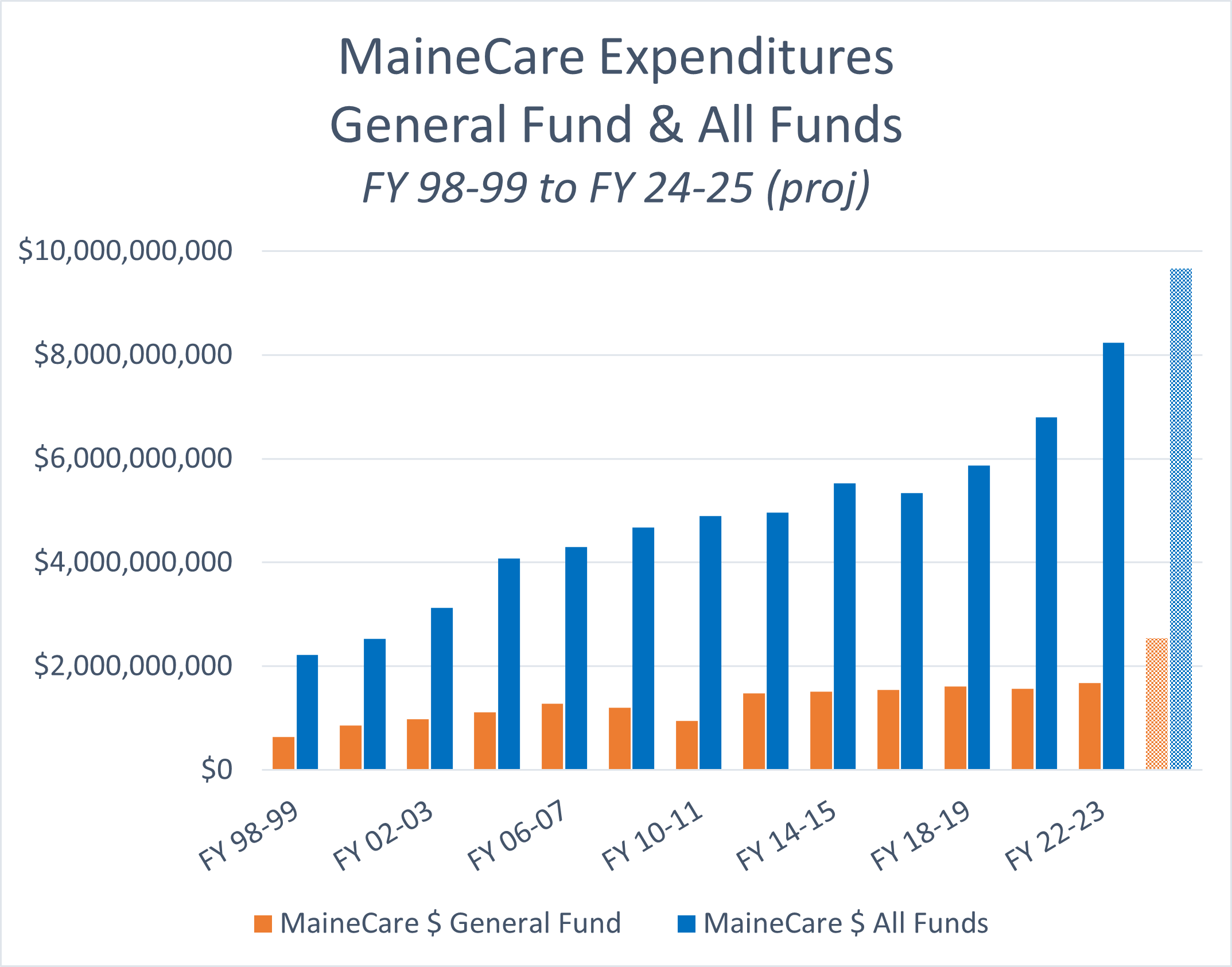
The rising blue and orange bars on the left depict an initial period of considerable MaineCare growth. The middle period shows relative stability, with the slight spike in the blue bar in FY 2014-2015 resulting from the federal share of state government paying overdue bills to Maine’s hospitals in FY 2014 (more below). More recently, MaineCare’s renewed outsized growth is unmistakable in the rising bars on the right side of the graphic.
For additional context in understanding the current challenges that increasing MaineCare costs are presenting to General Fund budget stability, it is helpful to zoom in on the program’s General Fund expenditures for each of the three decades considered above. As a matter of serendipity, the decades separate pretty cleanly into three distinct MaineCare “eras.”
MaineCare 2000s
Noting the decade bleed of the late 1990s into the 2000s, this analysis picks up in FY 1998-1999.23 Without detouring into policy review, it is important to know that Maine entered into an initial period of Medicaid expansion in the early 2000s.24 Doing so had the effect of driving substantial increases in enrollment and expenditures in what was an already growing MaineCare program.25
From the late-1990s to FY 2006, MaineCare General Fund spending grew by more than 150% ($256 million in FY 1998 as compared to $658 million in FY 2006). After having consumed an average of 13.6% of total General Fund expenditures annually for the five-year period from FY 1994 to FY 1998, that figure had increased to 23.3% by FY 2006. Spending flattened in FYs 2007 and 2008, after which MaineCare General Fund expenditures declined precipitously during the financial crisis years of FY 2009, FY 2010 and FY 2011.
The graphic below depicts total MaineCare General Fund expenditures from FY 1998 to FY 2010 and the percentage of Maine’s General Fund budget dedicated to Medicaid annually during those years.
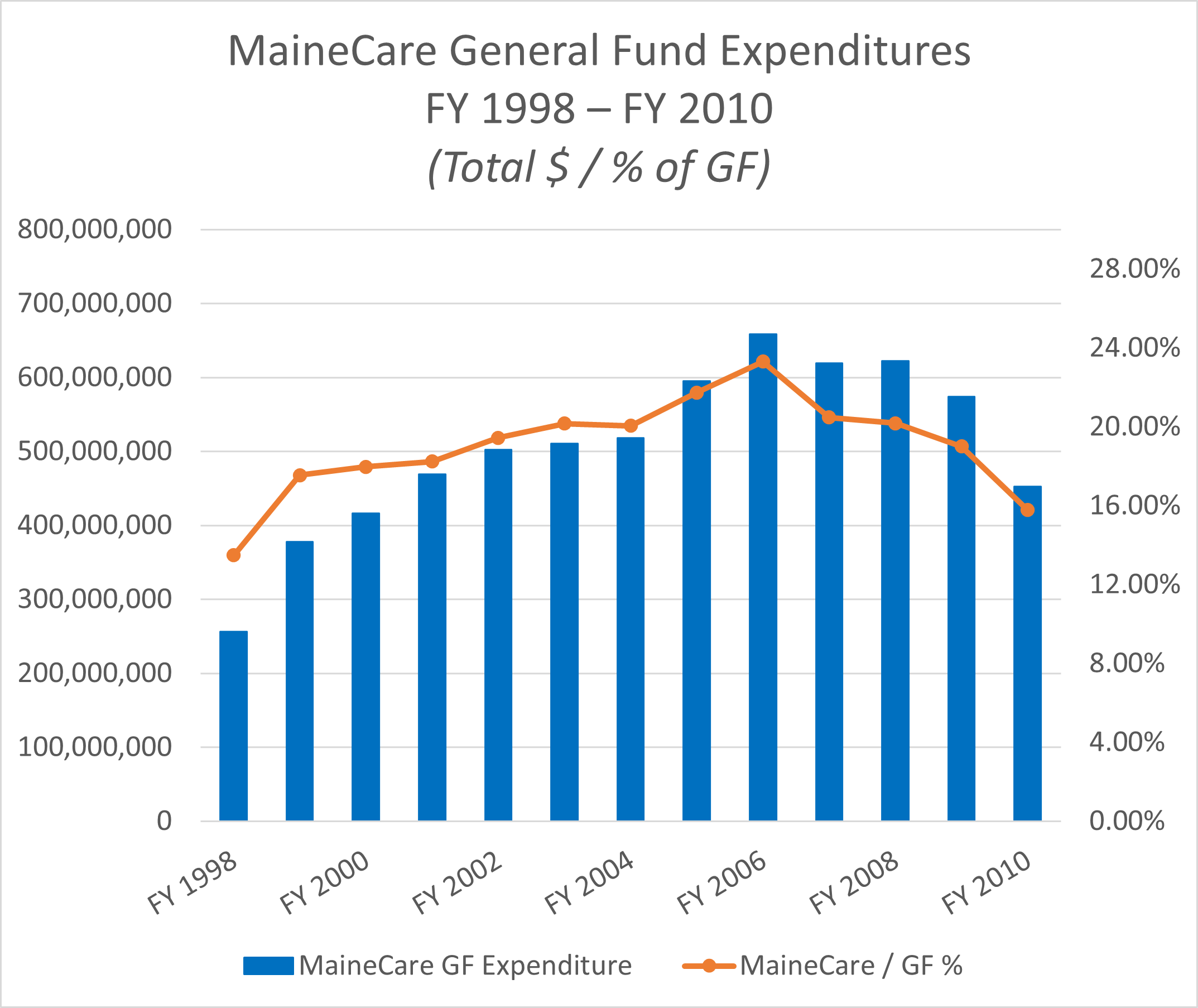
The major decline in MaineCare General Fund expenditures at the end of this period resulted from the financial crisis and its effects on Maine. After reaching a decade-high General Fund revenue level of $3.087 billion in FY 2008 ($4.452 billion in today’s dollars), revenue declined to $2.811 billion, $2.755 billion, and $2.944 billion in the following three fiscal years. Facing General Fund shortfalls, state government limited payments to Maine hospitals for Medicaid services as a means of preserving cash flow. This Portland Press Herald story, “Maine’s debt to hospitals approaches $500 million,” summarizes the situation well; wherein, state government accumulated significant debt to Maine hospitals over a several-year period beginning in 2009.26
The decline in MaineCare General Fund expenditures at the end of the decade reflected in the graphic above resulted from those suspended payments as well as an enhanced FMAP rate (74.35% and 74.86% for Maine in FYs 2009 and 2010, respectively) enacted by Congress in response to the financial crisis.
MaineCare 2010s
As a candidate in 2010, future Governor Paul R. LePage committed, if elected, to paying state government’s debt to Maine’s hospitals as well as to reinstituting timely payments to MaineCare providers. He accomplished both objectives.27 More broadly, Governor LePage and DHHS Commissioner Mary Mayhew committed to returning MaineCare to sound financial footing. They did, and in so doing—along with implementing granular program forecasting measures—significantly enhanced state government’s budget stability during the 2010s.
The following graphic covering the 2010s demonstrates the effect of (1) restoring payments to the hospitals; (2) establishing a level of MaineCare expenditures that state government could afford; and (3) increased spending due to Medicaid expansion in FYs 2019 and 2020.28
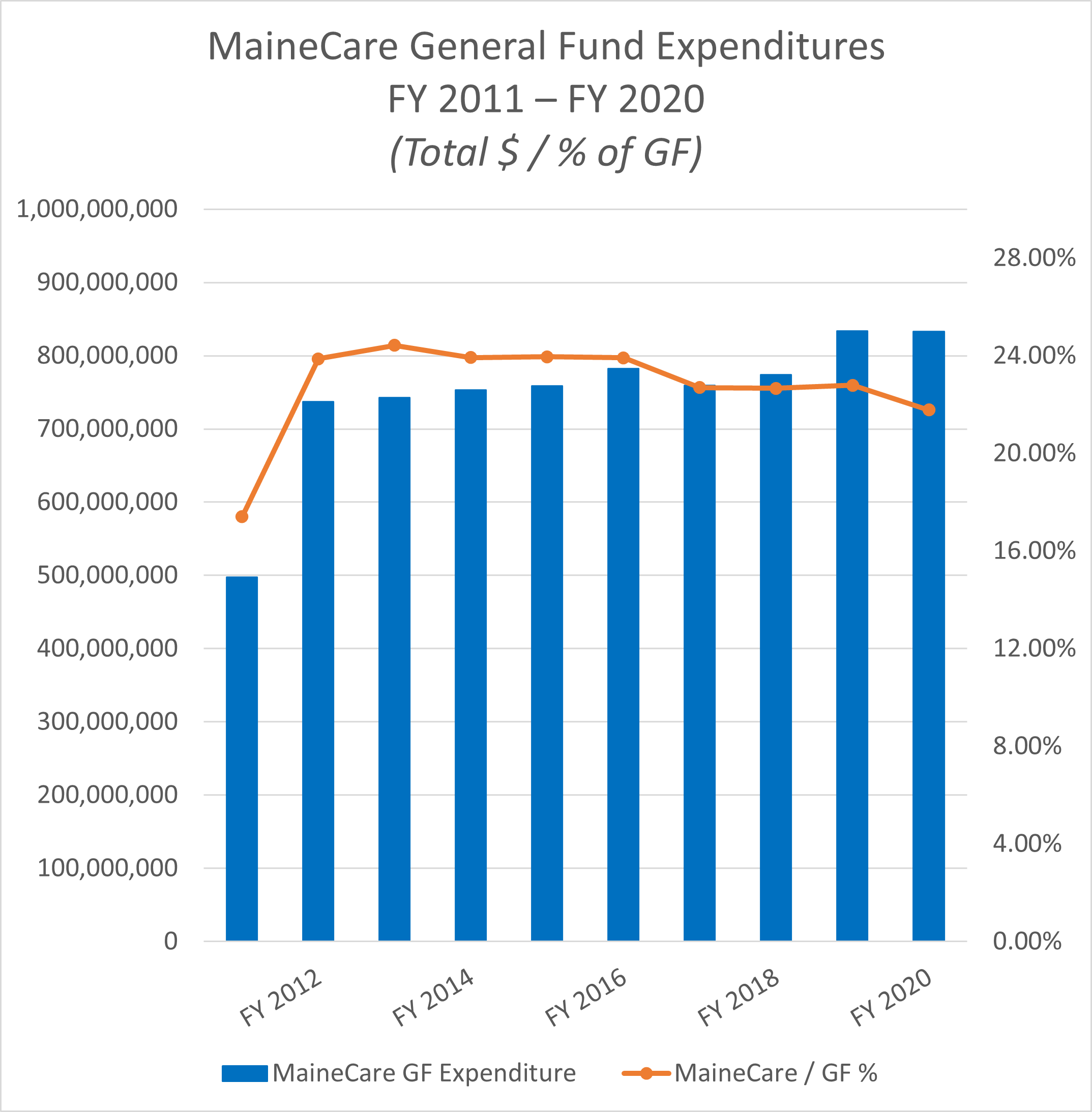
As noted, the steadiness and predictability of MaineCare expenditures throughout most of the 2010s was a key factor underpinning Maine’s overall state budget stability during those years.
MaineCare 2020s
After an extended period of stability, the percentage of Maine’s General Fund budget dedicated to MaineCare has increased sharply in recent years. As discussed, part of this has been due to overall cost increases in the program, and another part has resulted from a declining FMAP rate.
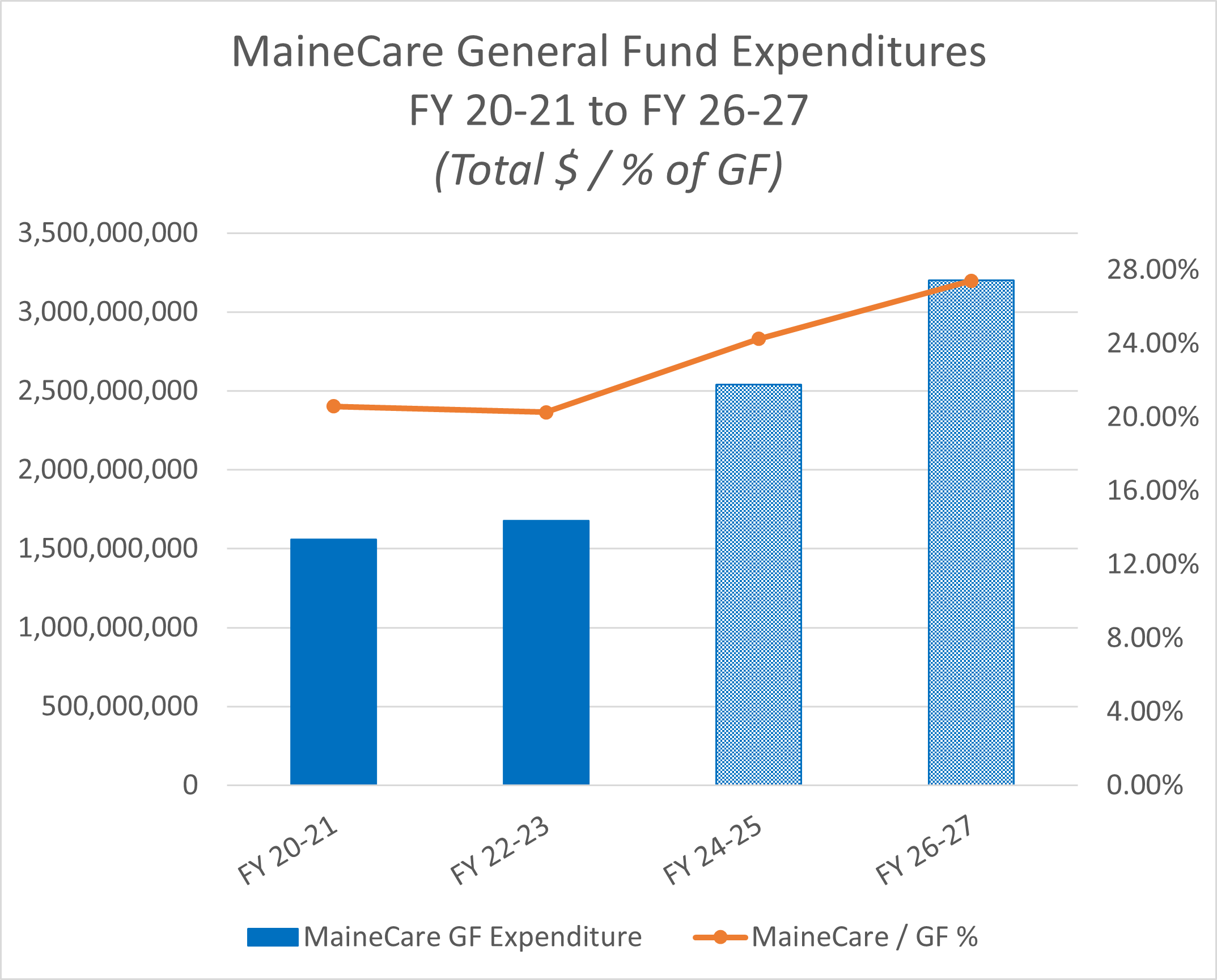
The following graphic depicts MaineCare expenditures during the 2020s. Note: this is the same format as the graphics above. Expenditures are grouped by biennia (rather than annually), however, as projected totals for the current biennium and the next one are readily available in the Four-Year Forecast (pp. 13-14).29
With respect to total program growth and the FMAP rate:
First, total MaineCare spending has increased throughout the decade. From FY 2020 to FY 2024, All Funds MaineCare spending (i.e., including federal funds) increased by more than $1.3 billion, or 41% — and an average annual growth rate of 9% for the four-year period. If FY 2024 All Funds expenditures of $4.625 billion increase by the same 9% rate in FY 2025, MaineCare’s total annual spending would be north of $5 billion for the first time.
Second, after an increase during the early years of the pandemic, Maine’s FMAP rate has declined since FY 2023. From ~70% during FYs 2020 to 2023 to ~61% for FY 2026, the rate will be down by ~13% (or nine percentage points). This resulted from two reductions. First, as expected, the federal government discontinued the enhanced FMAP period following the end of the pandemic, reducing Maine’s FMAP rate from 69.49% in FY 2023 to 62.65% in FY 2024. Second, Maine’s FMAP rate has declined since then as a result of per capita income growth in our state in recent years. From 62.65% in 2024, our FMAP dropped to 62.06% in FY 2025 and will drop to 61.29% in FY 2026.30
The dual dynamic of increasing total program costs and a declining federal payment share of it, then, is the impetus for the sharp upturn in the orange line and shaded blue bars in the graphic above. The two reflect a greater percentage of Maine’s General Fund budget dedicated to MaineCare and increased MaineCare General Fund spending, respectively. The result is that, comparing today—and the foreseeable future—to the beginning of the decade, state government is now paying a larger portion of the costs of a much more expensive program.
REALITIES OF MAINECARE SPENDING GROWTH
Two realities are clear when it comes to MaineCare spending growth during the 2020s. The first is that program spending growth at the current rate is unsustainable. The second is that the program’s current budget challenges were predictable.
Unsustainability of MaineCare Spending Growth
To the first, Medicaid expansion was always going to be a costly proposition. That is not to reenter an old debate but simply to acknowledge an important fact. Even though the federal government covers 90% of costs for the expansion population, 10% of a large amount is still significant, and the latter has held true for MaineCare expansion. In the first year of Maine’s Medicaid expansion, FY 2019, MaineCare General Fund expenditures increased by nearly $60 million, or 7.7% — a sharp upturn from average annual growth of about 1% during the prior six years.31
While the enhanced FMAP rates of the next four fiscal years depressed General Fund costs of the program, total MaineCare costs increased throughout the period. From FY 2020 to FY 2024, MaineCare All Funds costs rose from $3.280 billion to $4.625 billion. As noted above, that represented a 41% expenditure increase in just four years. Even accounting for the high inflation of those years, it was still a real spending increase of about 16% over four years during a time when Maine’s population grew by 3%.32
Since the enhanced FMAP rate was always set to decline, increasing total program costs by about 9% annually during the pandemic ensured that by mid-decade—i.e., when the enhanced FMAP ended—MaineCare costs to the General Fund would rise considerably. They did.33
The graphic below shows this dynamic over the course of the post-MaineCare expansion period. The key dynamics are the steadily rising blue bars (MaineCare All Funds spending) and the declining green line (Maine’s FMAP rate), which results in the rising orange bars (MaineCare General Fund expenditures).
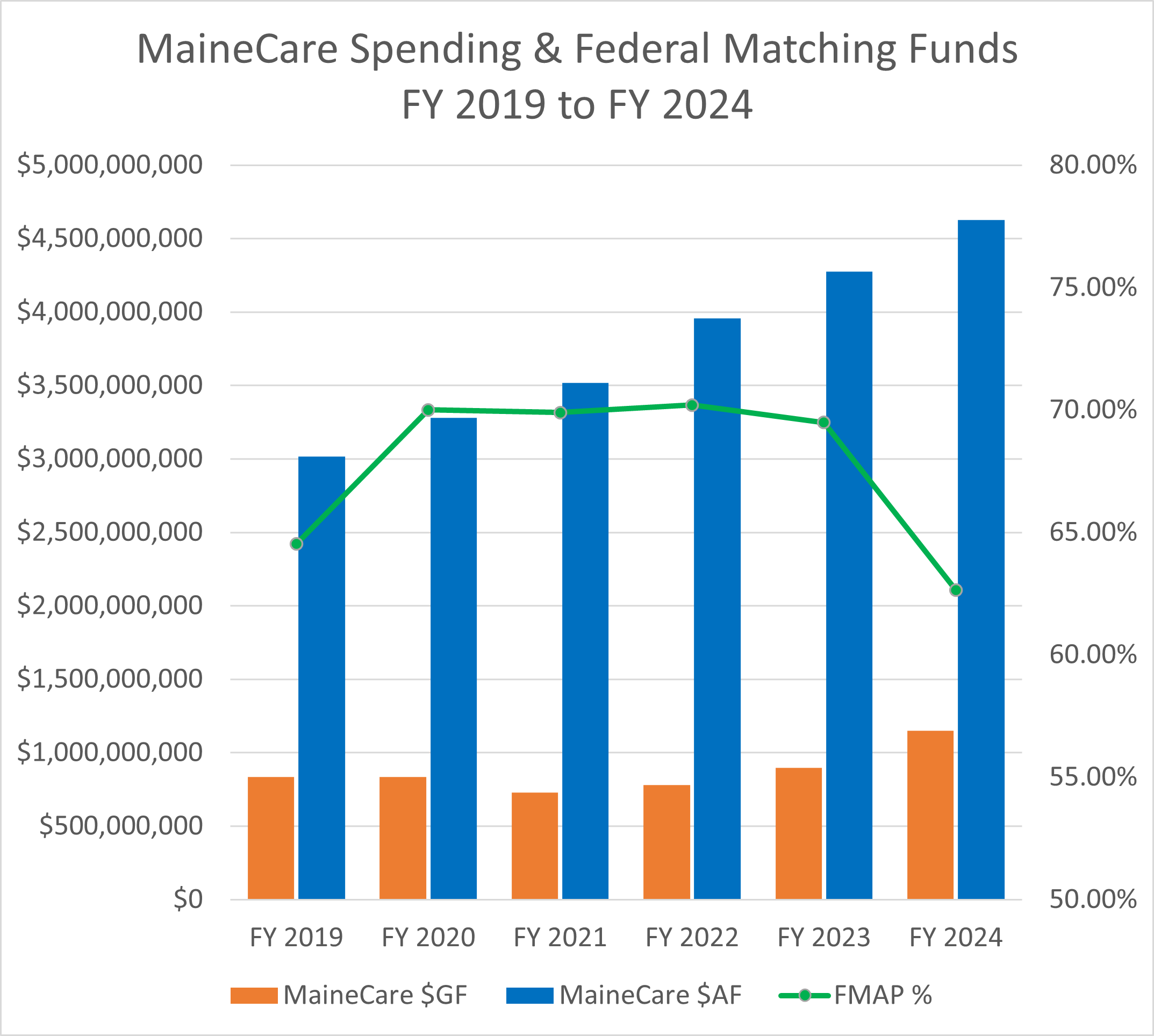
The mix of program dynamics driving today’s MaineCare expenditure levels are clear in the graphic. Total program costs were increasing throughout this period (~9% annually); for a time, FY 2020 to FY 2023, the enhanced FMAP meant that the federal government paid for a greater portion of Maine’s Medicaid costs than it typically does; then, when the federal match returned to its historical level, state government was left paying for far greater MaineCare expenditures from the General Fund than it had in the recent prior years. Notably:
In the graphic above, because they are competing with far taller blue bars, increases and decreases of the orange ones are somewhat understated.
The jump, however, represented by those orange bars from FY 2023 to FY 2024 is 28%. For the first time, in FY 2024, MaineCare was a billion-dollar-per-year General Fund program ($1.149 billion).34
With the accompanying decline in General Fund revenue growth over the past several years, this has amounted to a major shift in trends from the beginning of the decade to the present seen here:
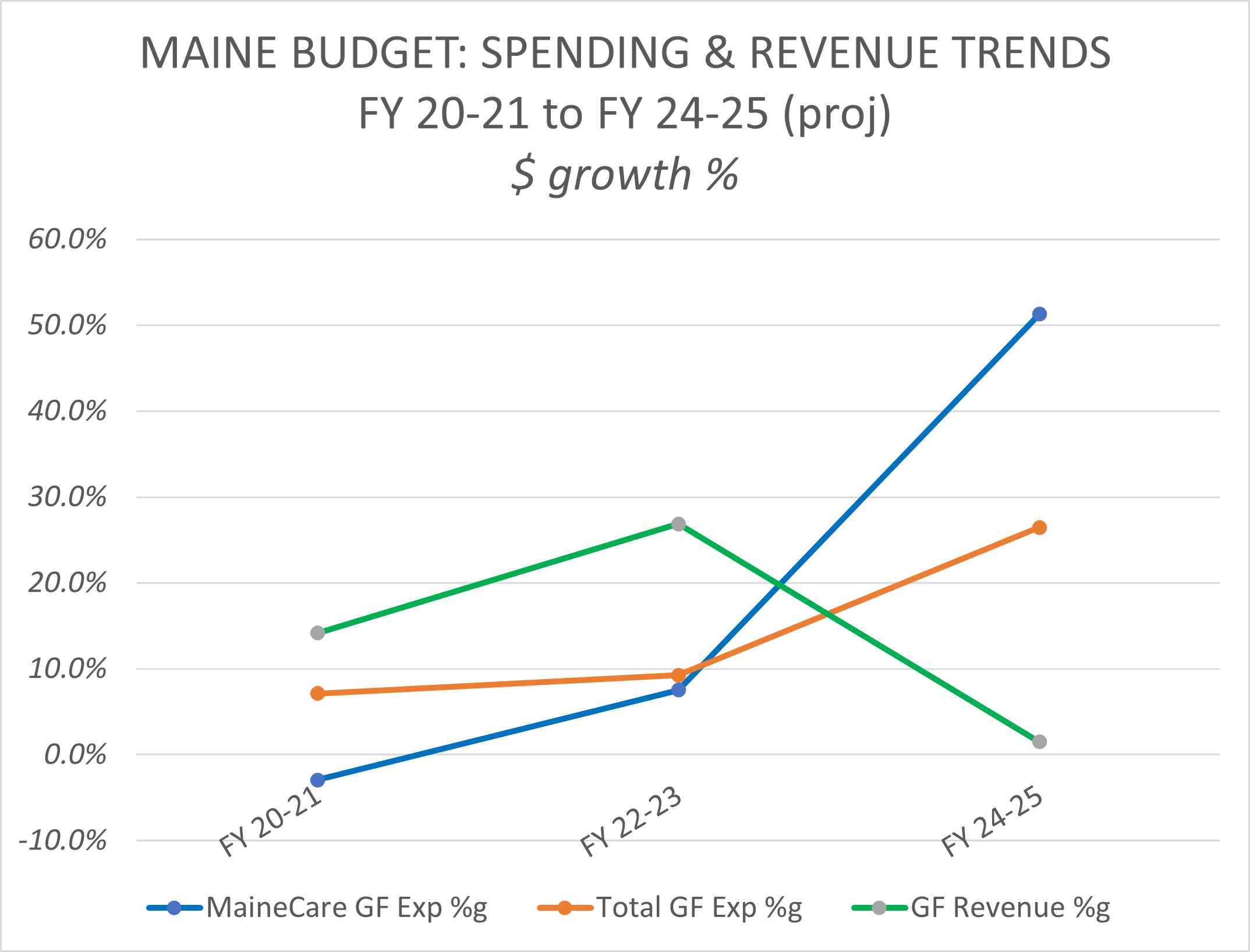
I include this graphic again because it conveys so clearly just how starkly these key growth rates have diverged. Continuing into the coming biennium at anywhere near these rates would be a big problem for Maine’s state budget.
On the positive side, because of the lower bases off of which FY 2024-2025 biennium spending (MaineCare General Fund and total General Fund) grew, rates of growth for both accounts should decline organically in the coming biennium. That effect is evident in this graphic:
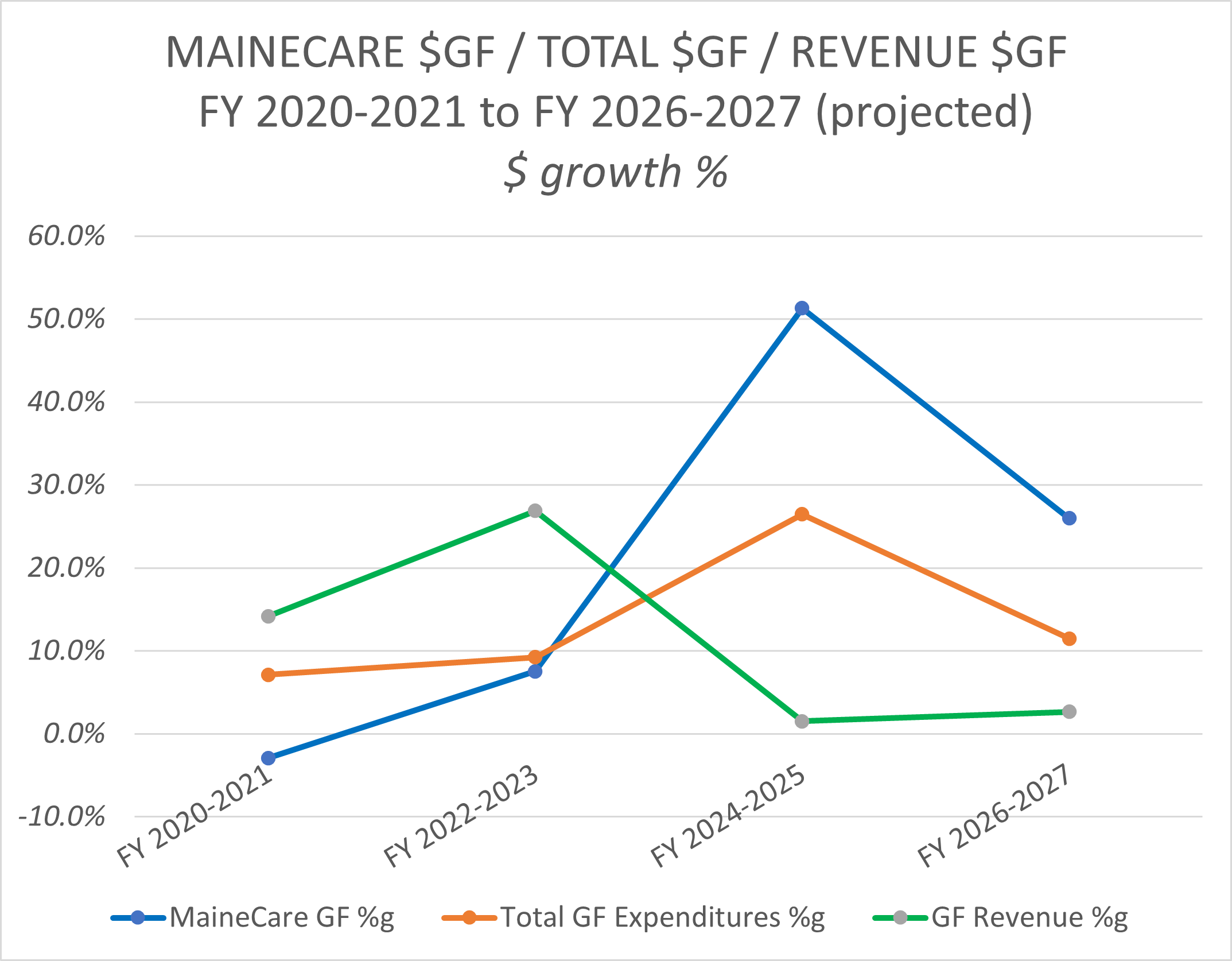
The outlook in this scenario improves markedly. Here, spending growth is based on the Four-Year Forecast projections — i.e., if policymakers simply confirmed, for FY 2026-2027, the statutory funding levels already in place. The convergence of spending and revenue growth rates, of course, would be an improvement over the present and certainly a positive development.
On the negative side, even at those reduced rates, that level of expenditure growth would still be higher than forecasted revenue growth and therefore unsustainable.
Further, based on (1) the broad departure from recent-year growth rates that the above scenario would represent; (2) the FY 2027 General Fund expenditures growth rate issue covered at length in the Commentary post — it is unrealistically low; and (3) a confusing note regarding MaineCare spending included in the Governor’s budget proposal (more below), I am skeptical that even these still-too-high rates of growth could come to fruition within the current budget structure.
Predictability of MaineCare Spending Growth
In its January 12 story, “How the pandemic ‘sugar high’ led to Maine’s budget crunch,” the Portland Press Herald noted the following regarding the projected budget shortfall for the coming biennium:
The deficit is driven mostly by increased spending to pay for laws that were passed when revenues were flush. Those built-in cost increases, totaling more than $1.1 billion over the next two years, are now projected to outpace revenue growth, according to the governor’s budget office.
The reference is to the beginning of the current decade when General Fund revenue rose dramatically over a several-year period, and the Press Herald’s observation is an important one. I would add a further point to complete the picture. Not only were revenues flush during those first few years of the 2020s, state government was—temporarily—responsible for a lesser share of Medicaid expenditures than it typically is. And yet, the enhanced FMAP was always going to end.35
Unfortunately, rather than acknowledging the uniqueness of the period (a revenue boom combined with temporarily reduced funding obligations in a major cost center of the budget), policymakers added other ongoing spending to the General Fund. All of that comes full circle to where state government is today — revenue growth that has returned to modest levels and far greater MaineCare costs (~$1.5 billion more annually than when the decade began) for which state government is responsible for a larger share.
CONCLUDING THOUGHTS
The steady, sustainable growth of MaineCare spending during the 2010s would be a welcome trend at this point. With (1) a large FY 2025 program funding shortfall to patch, (2) funding challenges in the coming biennium, and (3) outsized program spending growth rates, policymakers in Augusta should be focused on returning MaineCare spending to sustainable, predictable growth levels. Addressing the first two points is essential to meeting Maine’s constitutional balanced budget requirement. It would be a good start, but leaving the third point unaddressed would be budgeting malpractice and would negate those other accomplishments.
The Governor’s budget proposal includes a MaineCare spending level of $2.919 billion, or $280 million less than the statutory level of $3.199 billion included in the Four-Year Forecast. Credit to the Governor and her Administration for attempting to bring expenditures closer to a sustainable level. Having said that, my concerns follow:
The Governor’s proposed rate reductions are controversial (hospital-affiliated healthcare providers and behavioral health services providers have both raised strong objections) and will be difficult to implement. Those rate reductions will likely require legislative compromise, meaning less savings.
The proposed tax increases represent a revenue solution to an expenditure problem. Given the massive General Fund revenue gains of the early 2020s, state government really should be able to live within its current revenue means rather than taking more from an already overburdened Maine taxpayer.
The proposed spending downshift would result (at best) in a 9.8% two-year program spending growth rate — and that would still outpace projected FY 2026-2027 revenue growth of 2.7% by nearly four times. Also, MaineCare General Fund spending of 25% of the total General Fund budget would remain at a record level.
Lastly, there is a difficult-to-parse note on p. 24 of the budget proposal. I may be misinterpreting it but have returned to the note numerous times, at this point, without definitive conclusion. It may be fine. On the other hand, it may point to more underlying MaineCare budget pressure than the topline $2.919 billion budget proposal otherwise suggests. The full note is longer and appears in footnote 9, but the segment of interest is here (with my italics for the sake of italics):
The biennial budget for 2026-2027 includes $122 million in General Fund per year to stabilize the program and bridge the shortfall. In FY26, this results in appropriations exceeded [sic] the established limitation. The biennial budget includes language to notwithstand the limit for the one year.
Since the Governor’s budget proposal is $280 million less than the statutory level of $3.199 billion, I don’t understand the need for the $244 million “to stabilize and bridge the program.” As I said, there may be a clear reason for it. If so, great. It would be far better for Maine if MaineCare General Fund spending growth did not continue at an outsized rate and if a 5% annual growth rate were indeed in range for the coming biennium. But I don’t understand the $244 million shortfall bridging structure.
More broadly, in a pre-MaineCare expansion environment, the LePage Administration argued that rejecting such expansion was critical to keeping MaineCare spending at a level where it (1) did not cannibalize other parts of the state budget or (2) require broad-based tax increases to cover future spiraling costs. Those standards were for a different debate than the current one over the biennial budget. And yet, since Mainers were assured those things would not happen if state government expanded MaineCare, the standards themselves remain important ones to uphold as policymakers seek solutions to current program funding challenges.
Program spending. Considerable early 2020s revenue growth likely negated a MaineCare percentage rate cannibalization of other General Fund spending — that is because there was so much more General Fund revenue to go around. Future modest revenue growth levels, however, will not have the same insulating effect.
Taxation levels. As noted throughout, tax increases should be unnecessary. Republican legislators are right to oppose those increases. Even more, any broad-based tax increase to address MaineCare spending growth would be particularly unfair. Many Mainers who voted in favor of Medicaid expansion, which appears to be a large driver of MaineCare spending growth, did so with the understanding that the federal government would pay for the lion’s share of it — that expanded coverage would basically be free to Maine. To then face tax increases as a result of that goodwill would be an unfortunate bait-and-switch at a time when policymakers have already raised the cost of government on Maine workers at all income levels.
Next steps. A better course would be a detailed review of program spending, wherein legislators work with the Administration and program stakeholders to understand cost drivers and potential mitigation strategies for areas of outsized spending growth. Any successful effort to that end will be deliberate and transparent. It would be better if it were bipartisan. And it should avoid temporary, patchwork solutions that are easier to implement but only address a fraction of the problem and delay the same predictable (and likely greater) future budget challenges.
Medicaid expansion. This is a meatier topic and worthy of its own extended post. That said, any review of MaineCare designed to return the program to sound financial footing needs to study the early returns of program expansion. There are a number of different angles to determine the success or failure of this initiative, and this brief entry, as we have already run long, is not meant to be that. There are at least three areas of expansion, however, that warrant attention:
Enrollment has exceeded projections. MaineCare has grown by about 120,000 members since 2018, as compared to pre-expansion estimates of 70,000. The “continuous enrollment” standard of the pandemic years may account for some of this growth, so this figure will be an important one to watch.36
Program spending growth appears largely due to expansion. Given MaineCare General Fund spending grew by less than 1% on average during the six years prior to expansion—and the program now funds healthcare for about 40% more Mainers than it did during those years—it is fair to conclude that expansion is a primary driver of real MaineCare spending growth in recent years.
Reductions in the uninsured have been limited. Since expansion, Maine’s healthcare uninsured rate has dropped from 8% to 5.9%. In the five years prior to expansion, that rate dropped from 11.2% to 8%. Whereas MaineCare enrollment has increased by ~120,000, the number of uninsured in our state has dropped by 27,000. A question policymakers should ask in response to that development is, “has expansion simply shifted many formerly privately insured Mainers to the MaineCare rolls?”37
In reviewing the broader program, policymakers should seek to ensure that MaineCare runs as efficiently and effectively as possible. Among arguments in favor of expansion, proponents claimed that the latter would yield cost savings for the program. As MaineCare spending increases put pressure on the broader state budget, policymakers should ensure that those projected savings are maximized.
Thank you for reading. Please do not hesitate to ask questions or offer insight in the comments section. MaineCare finance is a reasonably complex topic. In my experience MaineCare policy is even more so. Given that the program accounts for about one-quarter of Maine General Fund spending (and growing) and, likewise, covers nearly one-third of Maine’s population, it is essential that state government get MaineCare as right as it possibly can — both in managing the program’s finances and in serving the nearly 400,000 enrollees who rely on it for their healthcare.
State Finance Commissioner is an informal title — the official one is Commissioner of the Maine Department of Administrative and Financial Services. For a detailed description of that role, please see the first footnote of the Commentary post.
In the FY 2024-2025 biennium (p. 13), MaineCare is projected to account for 24% or 25% of General Fund spending, as compared to 31% of spending from that account for K-12 education.
The 25% figure comes from the Four-Year Revenue and Expenditure Forecast (p. 13), which the Department of Administrative and Financial Services issued on September 30, 2024, with the addition of the $118 million FY 2025 MaineCare General Fund shortfall. While the Four-Year Forecast reports MaineCare General Fund spending as 24% of the total General Fund in FY 2024-2025, adding the $118 million to the MaineCare biennium total of $2.539 billion and the overall General Fund total of $10.470 billion boosts the 24% figure to 25.1% (2.657 billion / $10.588 billion = 0.251).
The General Fund is state government’s primary source of operating revenue. More than 85% of total General Fund revenue is derived from individual income and sales & use tax revenue, making the General Fund a good proxy for Maine taxpayer dollars. Unless otherwise specified, when policymakers or the press refer to state finances, they are usually referencing the General Fund. The same concept applies for this post.
While the General Fund is comprised of more than 40 different revenue yielding accounts—among them numerous taxes, fees, and other sources revenue sources—only the following six provided more than 1% of General Fund revenue as of FY 2023: Individual Income Tax (45.98%); Sales and Use Taxes (40.05%); Corporate Income Tax (8.39%); Insurance Premiums Taxes (2.12%); Cigarette Tax (1.98%); and Lottery Revenue (1.34%).
From there, the remaining revenue sources comprise a proportionately small amount of the General Fund and an additional three negative revenue accounts amount to about 6% in outlays from—and corresponding reductions to—General Fund revenue. These three accounts are: Transfers for Municipal Revenue Sharing (-4.90%); Tax Relief Program Transfers (-1.52%); and Contributions and Transfers from Other Funds (-0.59%). Figures for each of the contributing General Fund revenue accounts appear in the chart on pp. 90-91 in the FY 2023 State of Maine State Compendium of Fiscal Information. This document—referred to as the “State Fiscal Compendium” in this post—which the Legislature’s Office of Fiscal and Program Review compiles annually, dates back to 1962 and contains a wealth of data and information on Maine’s state budget.
This represents a doubling of real program spending over that time period given that $1.2 billion in the year 2000 equates to about $2.2 billion in today’s dollars. Accounting for the fact that Maine’s population has increased by nearly 11% since 2000, and rounding up, approximately $2.5 billion would be the same size program—for the equivalent number of Mainers—in FY 2025. About $5 billion in estimated All Funds MaineCare spending is double that.
The $5 billion figure itself is an estimate derived from the FY 2024 MaineCare All Funds expenditure figure of $4.625 billion (see next footnote) multiplied by a growth rate of 9% (also next footnote), which would equal $5.041 billion.
Up to and including FY 2023, the MaineCare figures (All Funds and General Fund) referenced throughout this post are derived from State Fiscal Compendia or this document for pre-FY 2005 figures (see footnote 8 for additional detail on historical MaineCare expenditure records). The FY 2024 State Fiscal Compendium is not yet available, so I have relied on the the DHHS FY2024 ME Care Expenditure-Week 52 Report for FY 2024 figures.
For FY 2024 MaineCare All Funds expenditures, I have used $4.625 billion, the “Grand Total / Cycle Total” figure (p. 4). This figure appears to exclude administration costs and I believe ties more closely figure to the prior years’ expenditure levels listed in the Fiscal Compendium than does the larger ($4.723 billion) “Grand Total” figure.
This webpage (at www.medicaid.gov) provides detailed background on pandemic-era enhanced federal matching funds. Effectively, they lasted from January 1, 2020 to December 31, 2023; therefore, the enhanced match affected Maine’s FYs 2020 through 2024 given our July 1 state fiscal year start date.
The four-year average MaineCare General Fund spending portion of overall General Fund spending for FYs 2020 to 2023 was 20.41% (p. 92 of the FY 2023 State Fiscal Compendium, MaineCare/Medicaid line item).
For the 25% estimate, see footnote 3. For the “record level,” the State Fiscal Compendium began breaking out MaineCare costs on a MaineCare/Medicaid line in the 2000s. Between Compendia back to FY 2005 (the FY 2009 document was the first edition that specifically listed MaineCare expenditures) and this document, we are able to see MaineCare as a percentage of the General Fund from FY 1994 to FY 2023. Others may have additional resources to identify MaineCare funding levels prior to FY 1994; however, given how much smaller the program was in those years (~13% to 14% of total General Fund expenditures), I think it is safe to say that the largest percentage of the General Fund, for which the program accounted, occurred at some point in the 2000s. That in mind, the largest percentage I can identify on record is 24.43% in FY 2013 — p. 88 here with comparison to the following four years.
The following note in the Governor’s FY 2026-2027 biennial budget proposal speaks to the reality of MaineCare budget challenges.
In Fiscal Year 2025 and into the 2026-2027 biennial, the MaineCare program is experiencing a funding gap stemming predominantly from significant MaineCare enrollment increases due to the federal COVIDera continuous enrollment requirement, as well as from increases in health care costs due to high inflation, increasing patient need, returning to pre-pandemic levels of service utilization, and reimbursement practices that do not control sufficiently for cost growth. The biennial budget for 2026-2027 includes $122 million in General Fund per year to stabilize the program and bridge the shortfall. In FY26, this results in appropriations exceeded [sic] the established limitation. The biennial budget includes language to notwithstand the limit for the one year.
Per the State Fiscal Compendium, MaineCare General Fund expenditures were $774.194 million in FY 2018 and $833.718 million in FY 2019, for an FY 2018-2019 biennium total of $1.608 billion. For the $2.657 billion figure, see footnote 3.
MaineCare All Funds expenditures: MaineCare All Funds biennial spending was $6.797 billion for FY 2020-2021 and $8.231 billion for FY 2022-2023. In the FY 2023 State Fiscal Compendium, p. 86 lists “Total Operating Expenditures” for “MaineCare/Medicaid” for FY 2023 and each of the four preceding years. For FY 2020-2021, MaineCare All Funds spending grew by 15.8% over the prior biennium. For FY 2022-2023, the rate was 21.1%.
For FY 2024-2025, I used $4.625 billion for FY 2024 (see footnote 5) and $5.041 billion for FY 2025. That combines for a biennial total of $9.667 billion, representing growth of 17.4% over the previous biennium for a three-biennia average of 18.1%.
$5.041 billion is derived by multiplying $4.625 billion by 1.09. The latter reflects the 9% annual MaineCare All Funds spending growth rate from FY 2020 to FY 2024.
MaineCare General Fund revenue. Per the Maine Revenue Forecasting Committee’s December report, projected FY 2026-2027 General Fund revenue ($11.224 billion) is expected to grow by 2.7% over that of FY 2024-2025 ($10.933 billion). Projected FY 2028-2029 revenue of $11.925 billion would then represent growth of 6.2% over FY 2026-2027 levels.
For FY 2022-2023, General Fund expenditures were $8.280 billion (p. 89). For FY 2024-2025, they are projected to be $10.588 billion (see footnote 3), representing an increase of $2.308 billion. For MaineCare General Fund expenditures, the FY 2022-2023 biennium figure is $1.678 billion. For FY 2024-2025, it is projected to be $2.657 billion’ therefore, the growth would be $979 million, or 42% of the total FY 2024-2025 biennial General Fund growth.
For FY 2026-2027, the figures would be as follows: total General Fund growth of $1.082 billion, of which MaineCare General Fund growth would be $542 million, or 50%. The latter figures are taken from the Four-Year Forecast (pp. 13-14), with the FY 2024-2025 figures updated per footnote 3.
Using the updated $10.588 billion projected General Fund expenditure for FY 2024-2025, FY 2026-2027 growth would be 10.2% per the Four-Year Forecast projected FY 2026-2027 General Fund expenditure of $11.670 billion. Per the Governor’s proposed $11.626 billion (p. 7), growth would be 9.8%. See footnote 11 for General Fund revenue growth.
General Fund revenue for the FY 2022-2023 biennium totaled $10.771 billion (p. 89). For FY 2024-2025, it is projected to be $10.933 billion (see footnote 11) — growth of 1.5%.
Per KFF data, and excluding the enhanced FMAP periods (next footnote), Maine’s average core FMAP rate from FY 2005 to FY 2026 was 63.08%.
I use the core FMAP throughout this analysis, but it is important to note that Maine’s effective FMAP rate in a given year is actually a blended one. This is for two reasons, the first of which is due to the different timing of Maine’s state fiscal year (July 1) and the federal fiscal year (October 1). The second results from the fact that the federal government covers the Medicaid expansion population at a 90% matching rate.
The latter is straightforward enough. With respect to the mismatched fiscal years, the federal government has announced that Maine’s FMAP rate in 2026 will be 61.29%. This rate, however, will not begin until October 1, 2025 — the beginning of the federal year. This means that Maine’s FY 2026 will already have been underway for one quarter when the new FMAP rate takes effect, so the FFY 2025 FMAP of 62.06% will be in effect for the first quarter of Maine’s FY 2026 and then the 61.29% rate will take effect of the following three quarters. Accordingly, the blended rate occurs when the first quarter FMAP rate of Maine’s FY 2026, 62.06%, is blended with the FMAP rate for the following three quarters of Maine’s FY 2026, 61.29%, for an average of 61.48%. Taking the example one step further, for Maine’s FY 2027 the rate will be a blend of one-part 61.29% and three-parts the FFY 2027 FMAP rate, which the federal government will assign to Maine in the fall.
The enhanced FMAP applied to FYs 2009 and 2010 with rates of 74.35% and 74.86%, respectively; and to FYs 2020 to 2024. For the latter, FYs 2020 and 2024 received the enhanced FMAP for one half of the state fiscal year. The amount was a lesser one in FY 2024 and not reflected in KFFs rate database. According to KFF, FYs 2020 to 2023 had the following respective rates: 70.00%, 69.89%, 70.20%, and 69.49%.
The latest available MaineCare caseload report from Maine’s Department of Health & Human Services shows total program enrollment of 418,381 as of June 30, 2024. In her January 28 budget speech, however, Governor Mills referred to “nearly 400,000 people” being enrolled in MaineCare, so some enrollment attrition may have occurred since June, and I have adopted the “nearly 400,000” enrollment characterization for this post.
The Governor’s budget proposal contains $2.919 billion in General Fund funding for MaineCare as compared to the Four-Year Forecast’s $3.199 billion. Notably, even the $2.919 billion would be more than 80% greater than the $1.608 billion MaineCare General Fund expenditure of the FY 2018-2019 biennium; whereas, the $3.199 billion would just about double it.
The financial crisis years, and those immediately following it, saw an extended period of state budget instability, in which MaineCare featured prominently. The following two articles capture the budget challenges and related political debate of the time.
2009: “Political tensions rise over $65 million MaineCare deficit” (Bangor Daily News)
2012: “Maine DHHS facing $100 million shortfall” (Portland Press Herald)
It is a common phenomenon for decades to overlap; and, in the case of MaineCare, the period from FY 1998-1999 to the financial crisis was distinct from the years prior to it. During the FY 1998-1999 biennium, MaineCare spending grew by ~40% from the prior one. For MaineCare General Fund biennia totals, I have added the two relevant years using the State Fiscal Compendia back to FY 2009 and this document back to FY 1998.
The All Funds figure is captured in the State Fiscal Compendium under “Total Operating Funds” — p. 86 in the FY 2023 Compendium. In addition to General Fund expenditures, those from the Other Special Revenue (OSR) account combine to capture total state spending on Medicaid. OSR revenue (dedicated for MaineCare spending) comes largely from Maine’s hospital tax and service provider taxes. The accounts are listed in this document.
The hospital tax (if controversial) is an important policy area of MaineCare (and state Medicaid programs, in general) because of its impact on the federal match that Maine and other states receive. That said, the hospital tax and overall OSR component of MaineCare is a narrower area of the program and not the focus of this post.
The projected General Fund figure come from the Four-Year Forecast (pp. 13-14). For the projected All Funds figure, see footnote 5.
See footnote 20.
This 2007 Commonwealth Fund Report provides a good summary of the eligibility expansions policymakers made to the MaineCare program in the early 2000s.
The graphics on p. 26 of this Kaiser Commission on Medicaid and the Uninsured report from 2005 shows the significant growth of MaineCare enrollment during the first half of the 2000s.
In discussing the $484 million still owed to Maine’s hospitals at publication of this article (December 18, 2012), the Press Herald noted the following about the debt accrual timeline:
The state’s share of the debt is $186 million. Some of it dates back to 2009, and it must be paid to free up about $298 million in federal matching funds that some hospital officials say they need desperately.
In at least one other article regarding hospital debt repayment, references a longer accrual period for the debt. According to the Bangor Daily News, “Red ink from the hospital debt stretched back at least a decade” as of this January 2013 article; and that, “Historically, payments owed to hospitals [were] largely left out of the DHHS budget.” I was not working in state government during this time period and do not know the history well. While I have cited any information I share to the relevant and reliable sources, I would be interested in other ones (or other perspectives) should those exist.
The following note included in each of the State Fiscal Compendia containing FY 2014 explains the mechanics of state government’s final repayment measure to Maine’s hospitals.
Fiscal year 2014 includes $306.7 million in federal matching funds for MaineCare’s $490.2 million settlement payment to hospitals as authorized under PL 2013, c. 269. The $183.5 million Other Special Revenue Funds state share of these payments was made from bond proceeds from the sale of liquor operation revenue bonds and is included as Revenue From Private Sources.
This story in the Bangor Daily News, “LePage signs bill to repay Maine’s Medicaid debt to hospitals” reports on the deal to effect the repayment. Also, this earlier BDN piece, LePage proposes state borrow money against future liquor sales to pay hospitals, provides additional insight on Governor LePage’s proposal prior to its adoption as well as to smaller hospital repayments effected earlier in Governor LePage’s first term. The ones prior to the $490 million settlement included sums of $70 million and $26 million, in 2011 and 2012, respectively — the two of which unlocked another $180 million in federal funds due to Maine hospitals.
Upon taking office in January 2019, Governor Mills issued an executive order executing MaineCare expansion retroactive to July 2, 2018 — i.e., for all of FY 2019.
For this graphic, and any analysis throughout, I use the projected General Fund MaineCare FY 2026-2027 expenditure of $3.199 billion unless otherwise specified (e.g., the Governor’s proposed FY 2026-2027 level of $2.919 billion).
See footnote 15 for discussion regarding blended rates. Notably, Maine benefited from the enhanced FMAP for the first half of FY 2024, as the federal government phased it out during that period of time. This www.medicaid.gov webpage contains the specific phase-out rates and timeline.
MaineCare General Fund expenditures grew from $774.2 million in FY 2018 to $833.7 million in FY 2019, a growth rate of 7.7%. From FY 2012 to FY 2018, MaineCare payments grew from $736.9 million to the $774.2 million noted above, or by 4.6%.
$3.280 billion in FY 2020 would be the equivalent of $3.997 billion in FY 2024. With an actual FY 2024 MaineCare General Fund expenditure figure of $4.625 billion, that represents real growth of 15.7%.
To determine percentage population growth, I use the U.S. Census and Maine State economist’s population totals of 1.363 million for 2020 and 1.405 million for 2024.
As KFF noted in a June 2023 issue brief, “Fiscal Implications for Medicaid of Enhanced Federal Funding and Continuous Enrollment,” the enhanced FMAP “was designed to support the costs of increased Medicaid enrollment and provide fiscal relief to states beyond the costs of enrollment growth.” The federal government created the program “in exchange for keeping individuals continuously enrolled during the pandemic.” Even as states, such as Maine, benefitted from an extended “phase down of the enhanced FMAP [that] was designed to provide continued financial support to states during the unwinding process and to mitigate sharp increases in state Medicaid spending,” the extended period of greater federal Medicaid reimbursement—and higher costs for states in turn—was clearly coming to an end.
For FY 2024 MaineCare General Fund expenditures, the MaineCare Accounts / General Fund / Subtotal line on p. 1 of the DHHS FY2024 ME Care Expenditure-Week 52 Report, $1.149 billion, is the figure I use for FY 2024. That line excludes Fund For Healthy Maine expenditures, and prior years captured on the cycle payments report match closely (but not identically) to those listed in the State Fiscal Compendium (e.g., FY 2023 MaineCare General Fund spending in the FY 2023 Fiscal Compendium is $897.0 million but is $906.9 million in the linked document). That may have to do with fiscal year-end settling of accounts. When the FY 2024 Fiscal Compendium is released, I will update the FY 2024 MaineCare General Fund expenditure figure if there is a material difference from the current estimate.
Footnote 33 contains KFF’s discussion of the federal government’s pandemic-era FMAP enhancement / continuous enrollment strategy. To complete the thought on reduced MaineCare General Fund expenditures during the pandemic, lower utilization rates likely played a role in depressing expenditures in FY 2021 and FY 2022, as well. In response to criticisms of MaineCare rate reductions in the Governor’s FY 2026-2027 budget proposal, the Mills Administration has noted:
“These MaineCare budget constraints are driven primarily by an increase in enrollment … a rebound in the utilization of health care services following the pandemic, and an increase in the cost of health care services due to inflation and workforce shortage.” (With my italics regarding utilization.)
According to the latest available MaineCare caseload report, as of June 2024, there were 418,381 Mainers enrolled in the program. The Governor made reference to “nearly 400,000 people” being enrolled in MaineCare during her January 28 budget speech.
In their January 2024 report, “Unwinding of Medicaid Continuous Enrollment: Key Themes from the Field” KFF said this about continuous enrollment:
During the COVID-19 pandemic, states kept people continuously enrolled in Medicaid in exchange for enhanced federal funding. With the end of continuous enrollment on March 31, 2023, states are required to complete an eligibility renewal for all Medicaid and CHIP enrollees by May 2024 – a process commonly referred to as “unwinding.”
For uninsured rates, I refer to the following sources:
Maine Public: “Maine Uninsured Rate Remains Below National Level.” The September 2017 article states: “According to a new federal report released Tuesday, Maine's uninsured rate of 8.6 percent is a drop from 11.2 percent in 2013.
Office of Governor Janet T. Mills: “Maine Has Largest Decline in Uninsured Rate Under Governor Mills According to New Federal Data.” According to this September 2022 press release, “The Governor highlighted a new report (PDF) from the U.S. Census Bureau showing that Maine’s uninsured rate dropped from 8.0 percent in 2019 to 5.7 percent in 2021…”
Maine Center for Economic Policy: “Census data shows most Mainers ahead compared to pre-pandemic — but poorest still struggling.” According to this piece, posted in September 2024:
Maine continued to have a historically low share of its population without health insurance. In 2023, just 5.9% of the population lacked health insurance, compared to 8% before the pandemic and as many as 11% before the implementation of the major provision of the Affordable Care Act in 2014.